

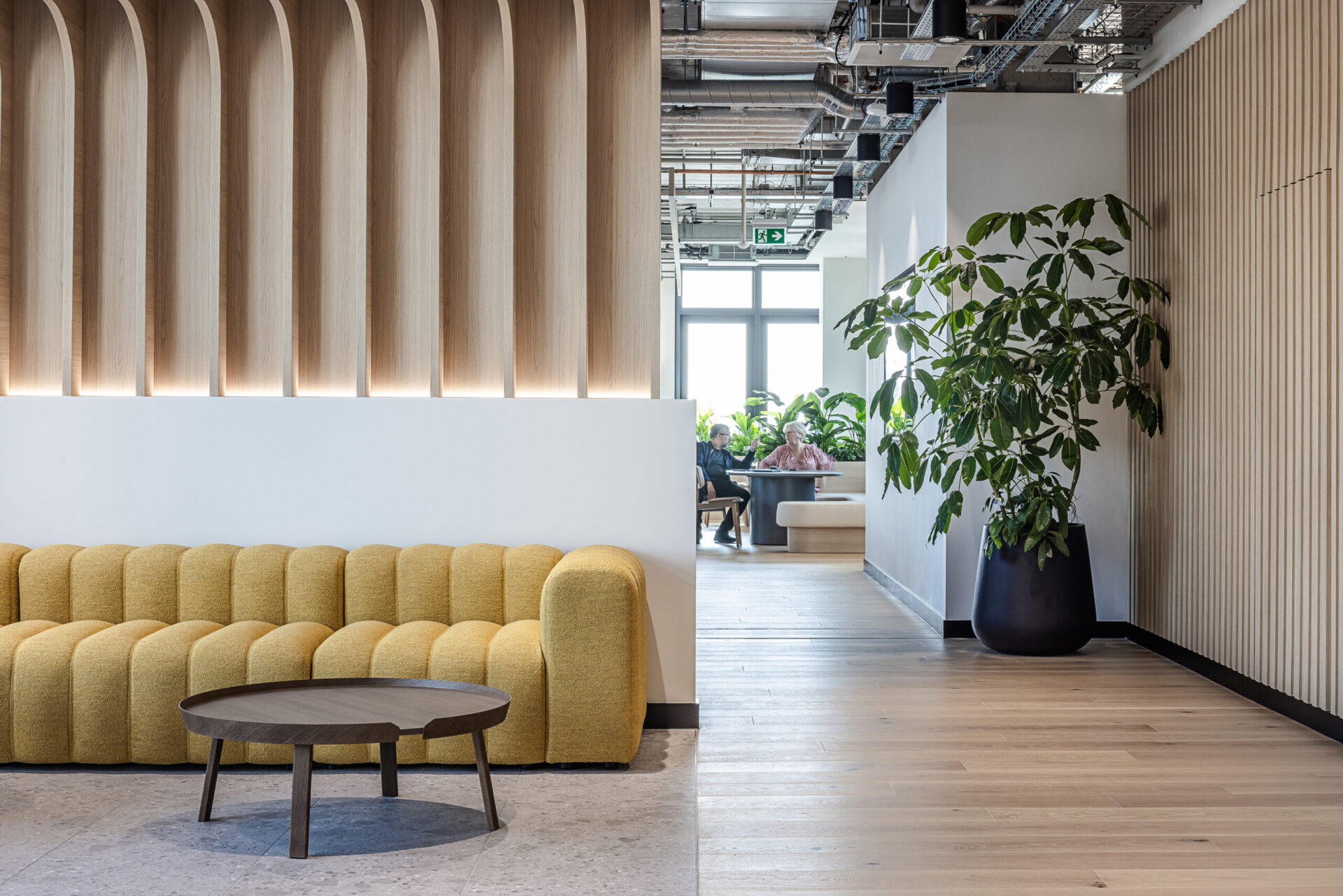
For developers and asset managers working in the Grade A commercial sector, understanding the financial mechanics of biophilic design is no longer optional – it’s a commercial necessity.
In 2024, 73.6% of London’s office take-up was Grade A space, and 68% of all transactions involved new or refurbished offices. In a market where tenants are increasingly selective about where they commit, the quality and character of the built environment has become a primary decision driver. As Lewis Silkin noted: ‘Corporate occupiers are seeking light, airy, green, flexible working spaces to retain and attract employees. ESG goals are at the top of most businesses’ agendas.’
The data supporting biophilic design specifically is increasingly robust. The Human Spaces global report, which surveyed more than 7,600 office workers across 16 countries, found that employees working in environments with natural elements reported 15% higher wellbeing, 6% higher productivity, and 15% greater creativity than those in conventional office settings. A 2024 study published in Scientific Reports found that indoor nature exposure increases employee wellbeing through improved energy, motivation and mental resilience – and critically, that this effect was not limited to people who actively sought out nature. The environment itself produced the benefit regardless of individual disposition.
Biophilic environments reduce physiological stress markers, a finding supported by the International Journal of Environmental Research and Public Health, which found that exposure to natural elements reduces cortisol levels and associated stress responses. In a commercial office context, this translates directly into occupier satisfaction, talent attraction and retention, and the renewal decisions that protect long-term income.
BREEAM-certified buildings (for which biophilic design elements including indoor plants, green walls and natural materials contribute directly to Health & Wellbeing scores) reportedly achieve over 20% higher valuations on average. In Central London at Q4 2024, the highest-quality office stock had vacancy rates of approximately 1%, while the lowest-quality stock faced vacancy of around 27% and rising. The divergence between best-in-class and second-tier assets is accelerating, and biophilic design is one of the most visible differentiators between them.
For developers, the implication is straightforward: a planting scheme is not a cost to be minimised at value engineering stage. It is a tenant-facing asset that contributes to WELL and BREEAM performance, supports occupier ESG reporting, and signals the quality of the building to prospective tenants from the moment they enter the reception.
The key word, as ever, is maintained. A scheme that deteriorates after practical completion is not a neutral event, it actively undermines the quality signals the building has worked hard to build, and creates a visible gap between the promise of the development and the reality of the occupied space.
This is why the most sophisticated commercial developers and asset managers treat planting not as a capital line item but as an ongoing investment – budgeted, contracted, and managed with the same rigour as any other building service. The financial return is real.
We’re here to help make it a reality.
Sources: Human Spaces Global Report (Interface / Terrapin Bright Green); Scientific Reports, 2024; International Journal of Environmental Research and Public Health; Lewis Silkin, 2024; UK Green Certification data, Level Workspace, 2026; BREEAM certification framework documentation.