

Ask a project manager what their most expensive problems look like, and the answer is rarely about the things that went wrong.
It’s about the things that weren’t coordinated – the interface between a planting contractor and a fit-out team, the specification that arrived too late to be built into the programme, or the maintenance regime that was never agreed before handover.
Planting is an asset class with unusual operational characteristics. Unlike stone, steel or glass, it’s… alive. It changes seasonally. It responds to light, temperature and humidity. It can be spectacular or dispiriting depending on what happens in the weeks after installation. Managing those characteristics well requires expertise, continuity and a relationship – and that’s not something you can bolt on at the end of a project.
The turnkey model – design, installation and maintenance contracted through a single specialist – addresses this directly. Rather than three separate conversations with three separate suppliers, a developer or project manager works with one partner who is accountable for the full arc of the planting scheme: from initial concept through to the living reality on site, years after opening.
The operational advantages are concrete. A single point of accountability means specification risk is owned by the contractor, not shared across a supply chain. Access requirements for maintenance are considered during design, not discovered during the first service visit. Plant selection is made with long-term performance in mind, not just opening-day impact. Replacement protocols are agreed in advance, not negotiated under pressure.
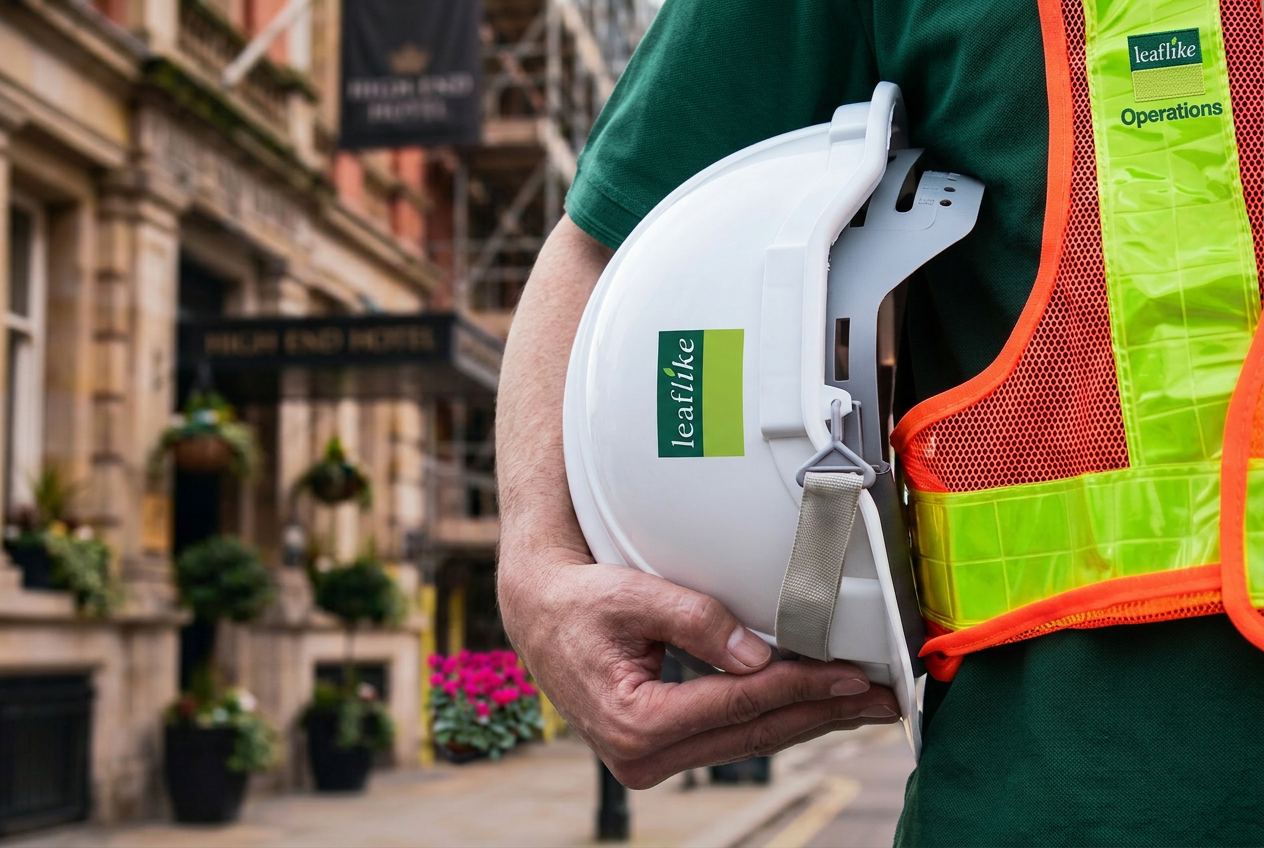
At Leaflike, this is how we have always worked. Over 25 years of hospitality projects, we have developed the processes, the supply relationships and the horticultural expertise to orchestrate every stage of a planting scheme – from the initial site survey and design interpretation through to the ongoing maintenance visits that protect the investment long after the client has moved on to the next project.
For developers and project managers, the question is not whether to use a turnkey partner. It is whether the one you choose can operate at the standard the property demands. On a prestige project, the answer to that question has consequences that extend well beyond opening.